What Are the Best Residential Solar Panels from China?
Choosing the best residential solar panels from China requires more than comparing wattage. A glossy datasheet cannot reveal every practical weakness. Roof orientation, local weather, shading, installation quality, and after-sales support matter just as much. A 450-watt panel may outperform a 500-watt model on a hot, partially shaded roof.
China remains a major force in global solar manufacturing. Its leading producers invest heavily in monocrystalline cells, n-type technology, automated production, and long-term testing. Fatih Birol, Executive Director of the International Energy Agency, described solar power as “the cheapest source of electricity in history.” That statement explains the opportunity, but it does not remove the need for careful product selection. Even respected brands offer different series, warranties, degradation rates, and temperature coefficients.
This guide examines residential solar panels from China through a homeowner’s lens. It considers efficiency, durability, low-light performance, warranty credibility, certifications, and installer compatibility. It also looks beyond famous brand names. A smaller manufacturer may offer strong engineering, yet weaker local service. That difference becomes important when a panel fails years after installation.
Real experience is rarely perfect. Roof measurements can be inaccurate. Product availability can change. Marketing claims can sound stronger than field results. Readers should verify current certificates, warranty terms, and installer credentials before purchasing. The best panel is not always the most powerful one. It is the panel that fits the roof, climate, budget, and maintenance expectations without creating avoidable surprises.
What Defines a High-Quality Residential Solar Panel from China?
The best residential solar panels from China are defined by measurable quality, not country of origin.
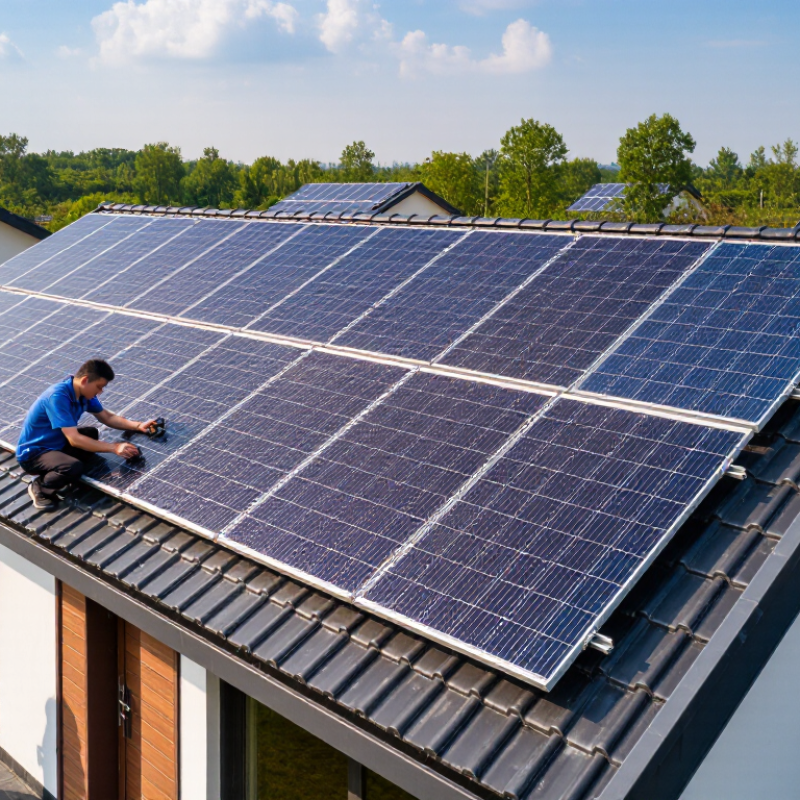
In a rooftop assessment, I look for stable output, careful manufacturing, and documentation that survives technical review. A panel should carry relevant IEC test evidence and clear electrical ratings. Its power tolerance should be narrow. That matters when twelve modules share one roof.
Real quality appears in less visible numbers.
Low temperature coefficients help during hot summers. Dark glass can become extremely warm under direct sunlight. Strong mechanical-load ratings matter in coastal or snowy areas. Encapsulant quality, sealed junction boxes, and controlled soldering reduce moisture-related failures. I also check degradation terms, warranty exclusions, and serial-number traceability. Paperwork can look polished. Independent testing deserves more weight than attractive specifications.
For homeowners, size and installer compatibility are practical tests.
Measure roof space, inverter voltage range, cable length, and local shade before choosing a high-wattage module. Larger panels may produce more power, yet they can be awkward on narrow roofs. A reliable supplier should provide inspection records, installation guidance, and a realistic service process. I would not trust a claim of “zero defects”; manufacturing still has variation. Even excellent modules lose output over time. Actual results depend on orientation, ventilation, dust, and workmanship. The uncomfortable question is whether the cheapest quote includes future support.
How Chinese Solar Panels Compare in Efficiency, Durability, and Cost
What are the best residential solar panels from China? The answer depends on efficiency, durability, roof conditions, and total project cost. Chinese manufacturers offer many monocrystalline panels with efficiencies commonly between 20% and 23%. However, advertised peak ratings need context. Heat, shade, dust, and winter light can reduce daily output. In practical assessments, compare temperature coefficients, low-light performance, and independent testing. A high number on a datasheet does not guarantee strong results on every roof.
Durability depends on more than the solar cells. Check the glass, frame, junction box, and resistance to salt mist, humidity, and freeze-thaw cycles. Recognized laboratory certifications and documented factory quality control add confidence. Chinese panels are often competitively priced because of large-scale production and established supply chains. Still, the lowest quote may exclude shipping, mounting hardware, installation, or future service. Warranty wording also matters. Some promises look reassuring until exclusions appear. I have found this easy to overlook.
Tips: Request a complete system quote, not only a panel price. Compare degradation rates, warranty terms, and test conditions. Ask the installer about local climate experience. Inspect roof shading during different seasons. Include inverter quality and monitoring access in your budget. Do not assume the cheapest panel delivers the lowest lifetime cost. Performance estimates can be imperfect, so leave room for real-world losses.
What Are the Best Residential Solar Panels from China?
This comparison uses representative midpoints from commonly published residential module ranges. TOPCon and HJT generally provide the strongest efficiency, while HJT typically offers the longest product warranty and lowest annual degradation. Cost competitiveness is based on indicative module-only pricing, with conventional mono PERC used as the baseline.
Technology reference values: mono PERC approximately 21.5% efficiency and US$0.12/W, TOPCon 22.5% and US$0.13/W, HJT 23.0% and US$0.16/W, and thin-film 18.5% and US$0.20/W. Actual prices, warranties, and performance vary by specification, market, and installation conditions.
Which Chinese Solar Panel Technologies Suit Different Homes?
Choosing Chinese solar technology for a home depends on roof space, climate, and installation conditions. PERC modules remain practical for larger roofs with moderate electricity demand. They are mature, widely available, and usually cost-conscious. However, their efficiency often trails newer designs. The Fraunhofer ISE Photovoltaics Report 2024 places leading commercial crystalline-silicon modules broadly above 22% efficiency, while older PERC products may sit lower.
TOPCon suits homeowners with limited roof area or hot summers. Its improved passivation can support higher output without changing the roof size. HJT technology is also attractive in warm regions because its temperature coefficient is commonly better than conventional silicon designs. That matters when dark modules reach high midday temperatures. Fraunhofer ISE reports commercial HJT efficiencies around the 23% to 24% range, depending on construction and measurement conditions.
For premium homes, back-contact modules can deliver strong efficiency and a cleaner front appearance, especially on visible roofs. They may cost more, and installation quality still matters. A shaded chimney can reduce production sharply, regardless of cell type. The IEA PVPS Trends 2024 report shows solar deployment continuing at exceptional scale, but global averages cannot predict one household’s yield. Roof direction, winter shading, inverter limits, and local temperatures deserve closer attention. Efficiency alone is an imperfect shortcut.
How to Evaluate Chinese Solar Panel Manufacturers and Certifications
What Are the Best Residential Solar Panels from China?
China remains central to solar manufacturing. The International Energy Agency reported that China held more than 80% of global solar manufacturing capacity in 2023. The IEA PVPS Trends 2024 report recorded about 447 GW of new photovoltaic capacity worldwide that year. Scale helps control prices, but it does not prove quality.
Evaluate each manufacturer through evidence, not polished brochures. Ask for IEC 61215 and IEC 61730 test reports matching the exact module model. IEC 61215 addresses design qualification, while IEC 61730 focuses on safety. Check whether an accredited laboratory issued the reports. ISO 9001 can indicate process control, but it is not a product-performance guarantee. Request factory audit records, serial-number traceability, warranty terms, and independent test results. NREL research commonly uses an annual degradation benchmark near 0.5%; unusually optimistic claims deserve careful questioning. A certificate is only a snapshot.
Tips:
Compare the same model across documents. Verify the laboratory’s accreditation. Inspect packaging photos, connector details, and the stated temperature coefficient. Ask for a recent electroluminescence sample. Do not rely on one successful installation. Even experienced buyers miss small inconsistencies. I have found that unclear warranty wording can matter more than a higher efficiency figure. Also, shipping damage and installer workmanship can reduce real output, although manufacturers rarely emphasize those risks.