When you invest in solar, you’re not just buying panels you’re investing in 25+ years of clean energy and savings. But here’s a fact many people overlook: solar panels don’t stay at peak efficiency forever. Just like any technology, they gradually lose some performance over time. This natural process is called degradation.
Why does this matter? Because even a small decline in efficiency impacts how much electricity your system generates, your solar investment payback period, and ultimately, your long-term return on investment (ROI). Let’s break down how solar panel degradation works, how it affects performance over 25+ years, and what you can do to keep your panels at their best
What is solar panel degradation?
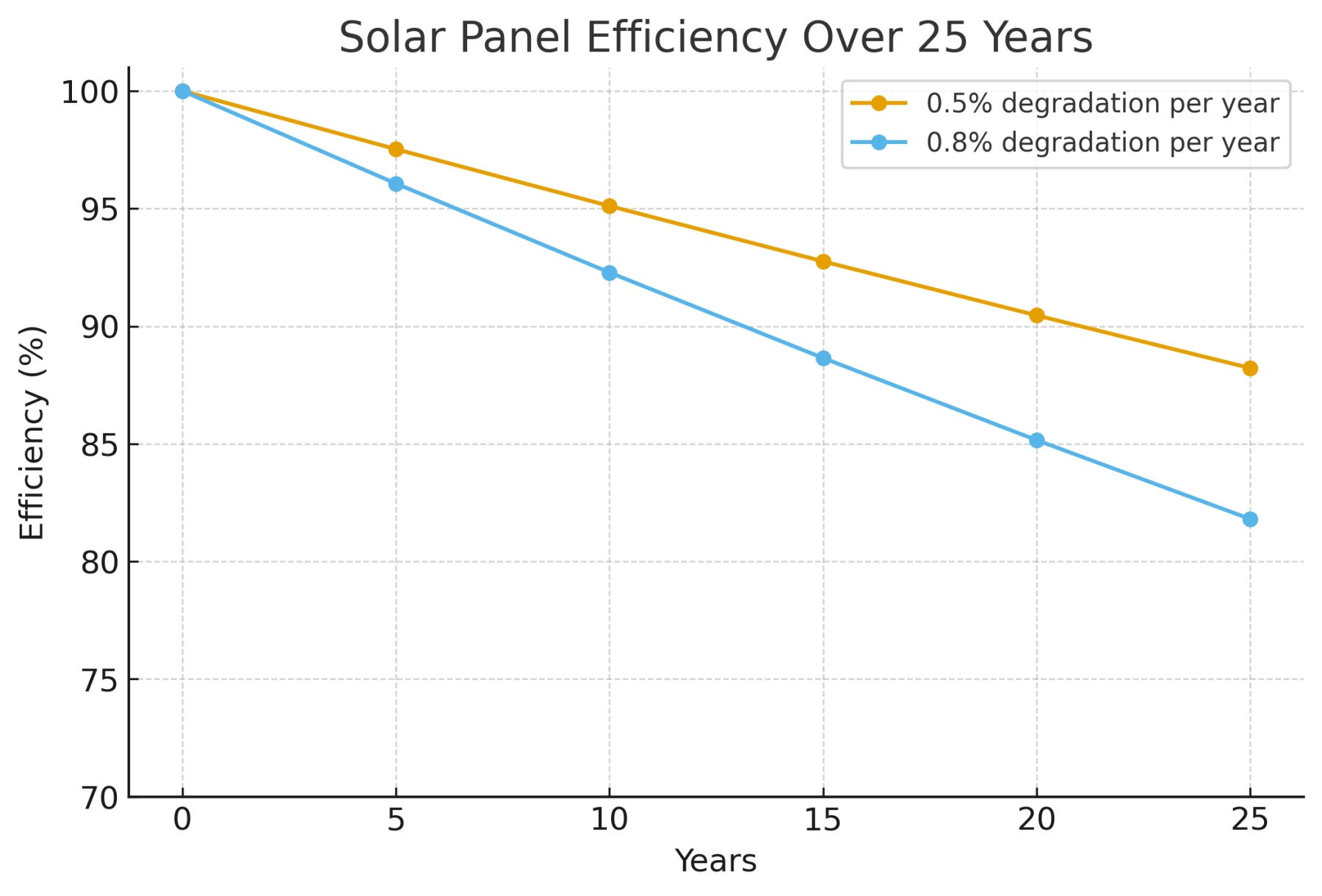
Solar panel degradation is the gradual reduction in power output as panels age. Most modern panels degrade at about 0.5%–0.8% per year.
That means:
- After 10 years → panels still deliver 92–95% of their original output.
- After 25 years → panels typically deliver 80–85%.
Several factors influence degradation:
- Panel quality: Tier-1 panels are designed for longer life expectancy.
- Climate: Extreme heat, humidity, or snow can accelerate wear.
- Maintenance: Dirt, shading, or neglect can reduce solar panel performance over time.
How Long Do Solar Panels Really Last?
Most manufacturers guarantee panels will retain at least 80% efficiency after 25 years. But real-world experience shows they often last longer.
- Panels installed in the 1990s are still producing power today.
- With proper care, panels can reach a solar energy system life expectancy of 30–35 years or more.
So when people ask, “Do solar panels lose efficiency?” the answer is yes, but much more slowly than many expect. Even after 25 years, panels continue to provide strong performance.
Here’s the big question:
How does this performance drop affect your savings and payback period?
Take a 5 kW solar system in India that generates about 7,000 kWh/year:
- At 0.5% degradation, after 25 years it still produces ~6,125 kWh/year.
- At 1% degradation, output drops to ~5,250 kWh/year.
That difference adds up to lakhs of rupees in lifetime savings. It also means your solar investment payback period could be shorter with better-quality panels since they maintain higher output for longer.
The takeaway: don’t just compare upfront prices factor in long-term energy yield and ROI.
Advances That Slow Down Degradation
Solar technology has improved dramatically, and today’s panels are engineered for durability. Key innovations include:
- PID-resistant modules that minimize Potential Induced Degradation.
- Improved encapsulation and coatings that reduce moisture and UV damage.
- Bifacial panels that generate power from both sides, improving efficiency over time.
Thanks to these improvements, solar panels today degrade slower than ever, giving owners better long-term returns.
How to Maximize Panel Lifespan?
As a solar owner, you can extend performance by following these steps:
- Professional installation – Proper angle, wiring, and layout reduce long-term stress.
- Regular cleaning – Dust and bird droppings can cut efficiency by 5–10%.
- Scheduled maintenance checks – Spot problems like loose connections or inverter issues before they grow.
- Monitoring tools – Track your system’s output and catch performance dips quickly.
Taking these measures not only maintains energy output but also protects your system’s life expectancy and ROI.
The Future of Solar Longevity?
The future looks even brighter. Researchers are developing 40-year solar panels with degradation rates as low as 0.2% annually.
Emerging technologies like perovskite-silicon tandem cells and advanced coatings may ensure panels retain 90% efficiency even after decades. This will redefine both solar performance over time and financial returns, making solar one of the most dependable long-term investments in clean energy.
Solar panel degradation is natural, but it happens slowly. A high-quality, well-maintained solar system can still deliver strong output after 25 years, ensuring a solid ROI and a reliable solar energy system life expectancy.
So when people ask, “Do solar panels lose efficiency?” The answer is yes but the decline is small compared to the decades of clean power and financial savings they provide.
✅ Ready to Make the Switch?
At Green World Renewable Energy, we specialize in designing solar systems that are built to last minimizing degradation, maximizing ROI, and delivering clean energy security for decades.
? Contact us today for a free consultation and find out how solar can power your future for the next 25+ years.
